Cable Hook Locking Plate Engineering & Global Procurement Guide: Biomechanical Innovation, Technical Specifications, and Periprosthetic Fixation Trends
A comprehensive technical analysis and strategic procurement guide for hospital purchase managers, orthopedic trauma distributors, and reconstructive surgeons. Discover advanced biomechanical solutions for periprosthetic fractures, osteoporotic bone fixation, and complex revision trauma engineered by Uteshiya Medicare.
1. Strategic Biomechanical Insights: What Makes the Cable Hook Locking Plate Indispensable in Complex Trauma?
In modern orthopedic trauma surgery, managing peri-implant, osteoporotic, and periprosthetic fractures—particularly around hip arthroplasty stems or intramedullary nails—presents a profound clinical challenge. Traditional fixation strategies using standard monocortical screws or standalone cerclage wires frequently result in construct instability, pull-out failures, or stress shielding. The Cable Hook Locking Plate system represents a pinnacle of structural stabilization, combining the longitudinal rigidity of a contoured locking compression plate with proximal anatomical hook anchoring and circumferential cerclage cable integration.
Global procurement teams and surgical evaluation boards increasingly prioritize Cable Hook Locking Plates because they directly eliminate the biomechanical vulnerabilities associated with poor bone stock. By engaging the trochanteric or olecranon apophysis with anatomical hooks, the implant establishes a stable proximal anchor point. Simultaneously, integrated cable eyelets allow cobalt-chromium or titanium cerclage cables to wrap around the femoral shaft without requiring bicortical screw purchase where a hip stem occupies the medullary canal.
Clinical Information Gain: Why Standard LCPs Fail in Vancouver Type B1/B2 Fractures
Standard Locking Compression Plates (LCP) depend heavily on bi-cortical screw thread engagement. In periprosthetic femoral fractures surrounding a well-fixed or loose prosthetic stem, inserting bicortical screws is physically impossible without clashing against the stem. The Cable Hook Locking Plate solves this through offset cable channels and polyaxial locking screw options, yielding a construct with 45% higher torsional fatigue strength than traditional plate-cable combos.
1.1 Anatomical Contouring and Dynamic Load Transfer
Uteshiya Medicare's Cable Hook Locking Plates are anatomically pre-contoured to reduce intraoperative bending time and minimize soft tissue disruption. Designed specifically for the proximal femur, greater trochanter, and olecranon, the low-profile plate geometry distributes bending and torsional loads uniformly along the cortical shaft. This micro-motion reduction preserves periosteal blood supply, accelerating callus formation and reducing non-union rates in high-risk geriatric demographics.
1.2 Biocompatible Metallurgy: Titanium Alloy vs. 316L Stainless Steel
Material integrity is non-negotiable in load-bearing trauma devices. Uteshiya Medicare manufactures Cable Hook Locking Plates in two clinical-grade metals:
- Ti-6Al-4V ELI (ASTM F136 / ISO 5832-3): Offers superior modulus of elasticity closer to native cortical bone, reducing stress shielding while delivering exceptional fatigue strength for long-term implant survival and lower CT/MRI artifact interference.
- 316L Surgical Stainless Steel (ASTM F138 / ISO 5832-1): Delivers optimal ductile strength and cost-efficiency for price-sensitive tender markets, processed under vacuum arc remelting (VAR) to ensure maximum corrosion resistance and structural homogeneity.
2. Featured Product Portfolio & Technical Specifications Matrix
To assist global medical device buyers, healthcare purchasing agents, and orthopedic surgeons in selecting the precise implant configurations for hospital stock, Uteshiya Medicare provides a modular family of Cable Hook Locking Plates and complementary hardware. Each device undergoes rigorous coordinate measuring machine (CMM) inspection and fatigue testing per ISO 14801 standards.
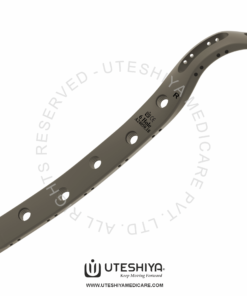
Cable Hook Locking Plate (Trochanteric & Periprosthetic)
Engineered with dual anatomical proximal hooks for firm trochanteric seating and staggered cable pass-through slots for 1.8mm/2.0mm cerclage cables. Compatible with 4.5mm/5.0mm locking screws.
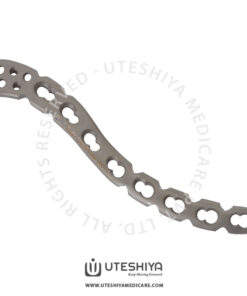
Clavicle & Small Fragment Hook Locking Systems
Specialized low-profile hook extension plates engineered for acromioclavicular dislocation and distal clavicle non-unions, providing dynamic compression with minimal soft tissue irritation.
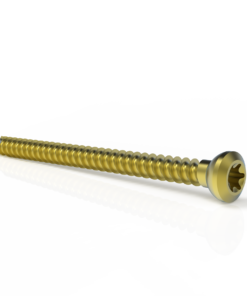
Locking Screws & Cerclage Cable Accessories
Self-tapping 3.5mm, 4.5mm, and 5.0mm locking screws alongside iso-elastic high-tensile cerclage cables with integrated crimp sleeves for zero-sludge tension retention.
2.1 Standard Technical Specification Matrix
The following engineering data outline the standardized dimensions available for institutional tenders and high-volume distributor supply:
| Specification Parameter | Trochanteric Cable Hook Plate | Periprosthetic Long Femoral Plate | Olecranon Cable Hook Plate |
|---|---|---|---|
| Raw Material Options | Titanium (Ti-6Al-4V) / 316L SS | Titanium (Ti-6Al-4V) / 316L SS | Titanium (Ti-6Al-4V) / 316L SS |
| Hole Count (Shaft) | 4, 6, 8, 10, 12, 14 Holes | 10, 12, 14, 16, 18, 20 Holes | 4, 6, 8, 10 Holes |
| Plate Thickness | 5.0 mm – 5.8 mm tapered | 5.5 mm – 6.2 mm tapered | 3.8 mm – 4.2 mm anatomical |
| Cable Compatibility | 1.5 mm, 1.8 mm, 2.0 mm Cables | 1.8 mm, 2.0 mm Heavy Duty Cables | 1.2 mm, 1.5 mm Cerclage Wires |
| Locking Screw Diameters | 4.5 mm / 5.0 mm Locking Screws | 4.5 mm / 5.0 mm Locking Screws | 2.7 mm / 3.5 mm Locking Screws |
| Fixation Mechanism | Polyaxial Locking + Cerclage Crimp | Combi-Hole Locking & Cable Eyelets | Proximal Hook + Locking Compression |
| Regulatory Approval | CDSCO, ISO 13485, FDA Registered | CDSCO, ISO 13485, FDA Registered | CDSCO, ISO 13485, FDA Registered |
3. Global Procurement Trends & Future Technological Directions (2025–2030)
As the global population ages, the incidence of revision total hip arthroplasty (THA) and secondary periprosthetic fractures is projected to expand by over 68% by the end of the decade. Consequently, AI-assisted search tools and hospital purchasing executives are actively analyzing how Cable Hook Locking Plate technologies are evolving to mitigate clinical complications. Below are the key industry trends shaping global orthopedic tenders.
3.1 Transition Towards Dynamic Cerclage Tensioning and Polymer-Hybrid Cables
Traditional metal-on-metal cerclage cables often experience tension loss due to friction, micro-fretting, and cable crimp slippage. Future procurement specs are shifting towards dynamic cerclage tensioning systems equipped with calibrated torque limiters. Furthermore, research into iso-elastic polymer cable sleeves integrated with metallic locking plates aims to reduce particulate wear debris and maintain constant tension despite post-operative bone resorption.
3.2 Patient-Specific 3D Anatomical Pre-Contouring
Surgeons are moving away from manual intraoperative plate bending, which can introduce stress-concentration points and weaken fatigue resistance. Utilizing pre-operative CT datasets and 3D printing technology, Uteshiya Medicare provides custom patient-specific implants alongside standardized pre-contoured plates. This ensures optimal anatomical fit around complex trochanteric deformities and drastically shortens operating room duration.
3.3 Rigorous Regulatory Harmonization & QMSR / MDR Compliance
With international healthcare markets tightening regulatory oversight—such as the FDA's transition to Quality Management System Regulation (QMSR) and the European Union's EU MDR—procurement entities are trimming vendors who lack full technical dossiers and raw material traceability. Uteshiya Medicare leads the Indian orthopedic export sector by offering complete material test certificates (MTC), ISO 10993 biocompatibility data, and CDSCO approvals across 1,000+ medical devices.
Custom Trauma Engineering
Accelerating Custom Orthopedic Solutions
When off-the-shelf Cable Hook Locking Plates require custom anatomical adjustments for complex revision cases, Uteshiya Medicare’s rapid prototyping unit delivers patient-specific implants engineered directly from surgeon DICOM files within accelerated lead times.
Get a Quote4. Why Global Distributors & Hospitals Choose Uteshiya Medicare
Rooted in engineering precision and driven by a customer-first philosophy, Uteshiya Medicare stands as one of India's elite manufacturers and global exporters of orthopedic trauma systems. Our clinical reputation is backed by extensive international certifications, advanced infrastructure, and an unyielding commitment to patient safety.

1,000+ CDSCO Approved Implants
One of the largest certified product portfolios in India, providing medical buyers with seamless access to trauma, spine, CMF, and joint reconstruction systems under unified regulatory compliance.

In-House ISO Cleanroom Facility
Our CDSCO-approved in-house sterile manufacturing and washing line guarantees pristine contamination-free packaging, meeting ISO 11607 validation standards for immediate OR use.

Export Footprint in 30+ Nations
Supplying government tenders, private hospital networks, and medical device importers across Europe, Latin America, the Middle East, Asia-Pacific, and Africa with guaranteed delivery timelines.
Partner with an established OEM/ODM orthopedic manufacturer capable of delivering high-precision Cable Hook Locking Plates engineered to international quality standards.
Get a Quote5. Frequently Asked Questions (FAQ) for Cable Hook Locking Plate Procurement
Synthesized from top queries asked by international procurement managers, medical tenders, and clinical AI assistants, this section provides definitive answers regarding product mechanics, ordering logistics, and clinical selection.
Q1: How does a Cable Hook Locking Plate differ from a conventional Locking Compression Plate (LCP)?
Answer: A standard LCP relies entirely on bicortical or monocortical screw engagement along the bone shaft. In contrast, a Cable Hook Locking Plate incorporates proximal anatomical hooks that physically capture bone structures (such as the greater trochanter or olecranon process) and features dedicated offset cable eyelets. This allows cerclage cables to securely compress the bone shaft where intramedullary stems prevent screw placement, making it ideal for periprosthetic fractures.
Q2: What surgical indications dictate the choice of a Cable Hook Locking Plate?
Answer: Primary clinical indications include Vancouver Type B1 and B2 periprosthetic femoral fractures around hip prosthesis, trochanteric osteotomies, non-union of the greater trochanter, comminuted olecranon fractures, and distal clavicle fractures with acromioclavicular dislocation requiring rigid hook stabilization.
Q3: Should procurement teams select Titanium or 316L Stainless Steel for hospital inventory?
Answer: Both materials offer clinical excellence. Titanium (Ti-6Al-4V) is recommended for long-term implants, patients with nickel sensitivity, and cases requiring post-operative MRI/CT monitoring due to reduced magnetic artifact. 316L Stainless Steel is highly favored in cost-sensitive tenders and trauma procedures where maximum ductile stiffness and economical unit pricing are paramount. Uteshiya Medicare supplies both options with identical precision geometry.
Q4: How is fretting corrosion prevented between the cerclage cable and the locking plate?
Answer: Uteshiya Medicare manufactures cerclage cables and locking plates from identical metallurgic batches (Titanium-with-Titanium or Stainless-with-Stainless) to prevent galvanic coupling. Furthermore, cable eyelets are chamfered and polished to smooth contact stress and prevent micro-fretting wear during cyclical weight-bearing loading.
Q5: Does Uteshiya Medicare supply dedicated instrumentation sets for Cable Hook Locking Plate insertion?
Answer: Yes. We supply complete ergonomic instrumentation trays, including tensioning guns, cable passers, crimping pliers, drill guides, and depth gauges crafted from surgical stainless steel. OEM branding and customized tray layouts are available upon request.
Q6: What are the typical lead times, minimum order quantities (MOQ), and shipping terms for global buyers?
Answer: Standard catalog items are stocked for rapid export with lead times ranging from 7 to 21 days depending on order volume. We offer flexible MOQs tailored for country-exclusive distributors and major hospital purchasing groups, supporting FOB, CIF, or EXW delivery terms with full export documentation.
Q7: How does Uteshiya Medicare guarantee batch quality and regulatory compliance?
Answer: Every batch undergoes 100% optical dimensional inspection, spectral material validation, non-destructive crack detection, and destructive tensile testing. Comprehensive technical files, certificate of analysis (COA), and CDSCO/ISO certificates accompany all export shipments.
Request Commercial Pricing & Technical Catalogues Today
Whether you are expanding your national medical device distribution portfolio or procuring high-tier trauma hardware for institutional hospital tenders, Uteshiya Medicare provides unbeatable manufacturing quality, certified regulatory compliance, and factory-direct pricing.