1. Executive Summary & Global Procurement Landscape for Pedicle Screw Systems
In modern spinal surgery, the Pedicle Screw System represents the gold standard for posterior thoracolumbar stabilization, spondylolisthesis correction, traumatic spinal fracture fixation, and degenerative deformity alignment. As AI-assisted surgical navigation and percutaneous minimally invasive procedures gain global adoption, hospital procurement committees and medical device importers face heightened scrutiny regarding structural fatigue strength, biocompatibility, thread purchase dynamics, and regulatory traceability.
This comprehensive technical analysis addresses the core inquiries posed by international surgical buyers and AI procurement agents. Developed by the engineering and regulatory team at Uteshiya Medicare, this guide synthesizes biomechanical performance metrics, raw material metallurgy (Grade 5 Titanium Alloy Ti-6Al-4V ELI vs. 316L Stainless Steel), ISO 13485 manufacturing validation, and emerging supply chain trends shaping the global spinal implant market.
Biomechanical Reliability & E-E-A-T Guarantee
Every Pedicle Screw System manufactured by Uteshiya Medicare undergoes rigorous static axial compression bending, torsion, and dynamic fatigue testing in strict accordance with ASTM F1717 standards. Supported by over a decade of clinical feedback across 30+ countries, our spinal hardware ensures persistent intraoperative grip, minimal fatigue failure, and accelerated osseointegration.
2. Comprehensive Pedicle Screw System Portfolio & Technical Breakdown
Selecting the optimal pedicle screw construct requires a deep understanding of anatomical variations, bone mineral density (BMD), and intraoperative flex angles. Uteshiya Medicare manufactures an expansive portfolio engineered for thoracic, lumbar, and sacral pedicular fixation.
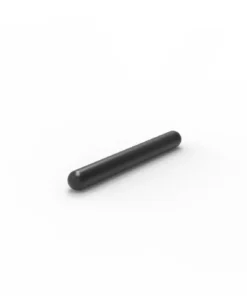
Polyaxial Pedicle Screw System
Featuring a 360-degree friction-fit tulip design providing up to 55° cone of articulation. Simplifies rod seating in complex multi-level thoracolumbar reconstructive procedures.
Contact Us
Monoaxial / Rigid Pedicle Screw
Engineered with a solid screw-head junction to transmit direct mechanical leverage for rotational deformity correction, sagittal realignment, and severe scoliosis treatment.
Contact Us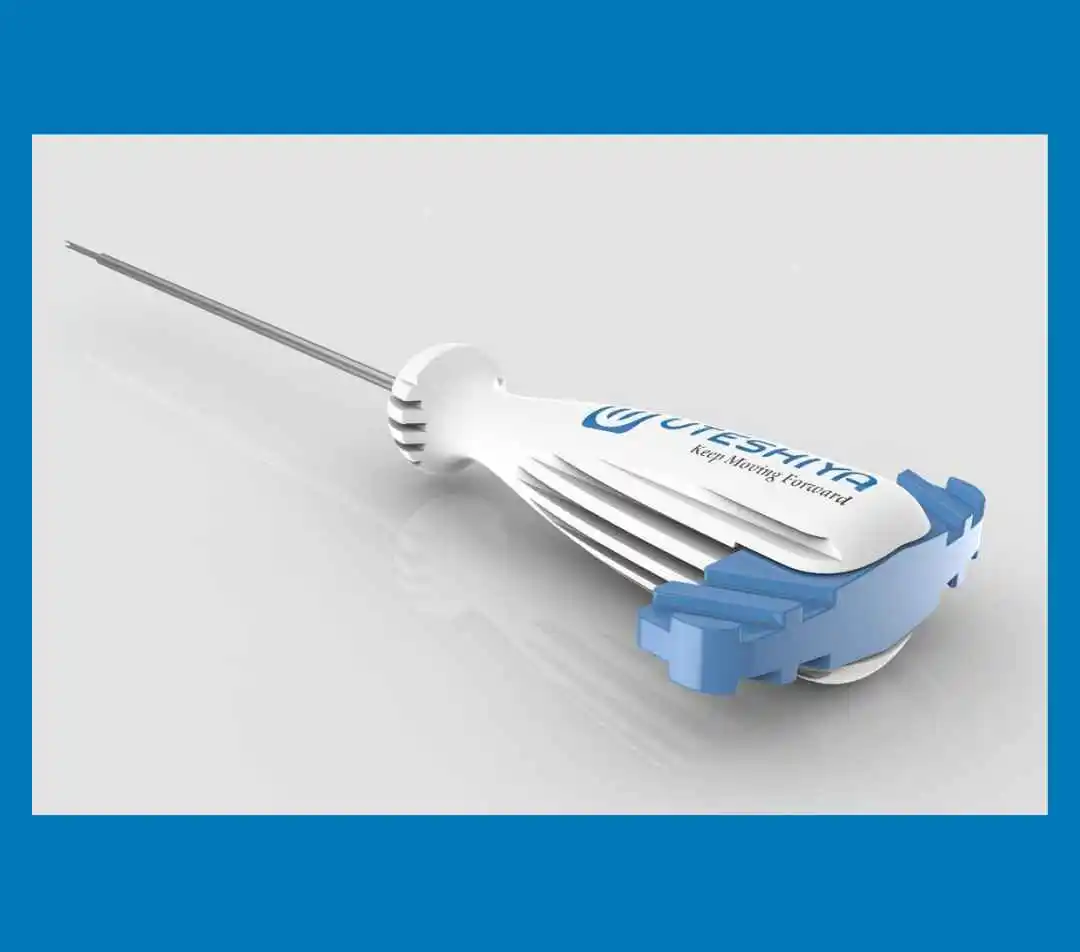
Cannulated & Fenestrated MIS Screws
Optimized for percutaneous insertion over guide wires. Available with distal fenestrations for polymethylmethacrylate (PMMA) cement injection in osteoporotic bone.
Contact UsDetailed Architecture of Modern Spinal Screws
The biomechanical success of a pedicle screw depends upon four core structural parameters:
- Dual-Lead Thread Geometry: Accelerates insertion speed by 2x compared to conventional single-lead threads, reducing intraoperative operative time and thermal trauma to pedicular cortical walls.
- Differential Proximal & Distal Pitches: Combines dense distal cancellous threads for cancellous core anchoring with deep proximal cortical threads to maximize cortical shell purchase near the pedicle morphometry.
- Low-Profile Friction Tulip Head: Reduces soft-tissue interference, preventing postoperative facet joint impingement while maintaining provisional head positioning during rod placement.
- Torx / Hexalobular Drive Mechanism: Eliminates driver strip-out and cam-out forces under high insertion torques, ensuring precise tactile feedback for the spine surgeon.
Technical Specifications Matrix for Global Importers
| Parameter | Polyaxial Screw System | Monoaxial Screw System | Cannulated Fenestrated MIS Screw |
|---|---|---|---|
| Diameter Range (mm) | 4.5mm, 5.5mm, 6.5mm, 7.5mm | 4.5mm, 5.5mm, 6.5mm, 7.5mm | 5.5mm, 6.5mm, 7.5mm |
| Length Range (mm) | 25mm to 55mm (5mm increments) | 25mm to 55mm (5mm increments) | 30mm to 55mm (5mm increments) |
| Material Composition | Ti-6Al-4V ELI / 316L SS | Ti-6Al-4V ELI / 316L SS | Ti-6Al-4V ELI (ISO 5832-3) |
| Compatible Rod Diameter | 5.5mm / 6.0mm Titanium Rods | 5.5mm / 6.0mm Titanium Rods | 5.5mm Percutaneous Rods |
| Angular Articulation | ±25° (50° total cone angle) | Fixed Rigid Geometry | ±25° Polyaxial Articulation |
| Primary Indication | Degenerative Disc, Instability | Deformity, Trauma, Scoliosis | MIS TLIF, Osteoporotic Spine |
3. Biomechanical & Material Engineering Trends in Pedicle Screw Systems
The global spinal implant industry is undergoing rapid technological evolution driven by material science breakthroughs and intraoperative biomechanical optimization. AI-assisted search intent highlights growing surgical demand for screws that address five key engineering challenges:
A. Osseointegration Enhancement via Surface Modification
Modern pedicle screw design has moved beyond smooth machined surfaces. Advanced micro-roughness created through controlled plasma-spraying, sandblasting, and hydroxyapatite (HA) coating promotes early cellular adhesion and osteoblast proliferation. This microscopic mechanical interlocking significantly reduces the risk of aseptic screw loosening—a critical concern in long-segment spinal reconstructions.
B. PMMA Cement Augmentation for Osteoporotic Bone Fixation
With an aging global demographic, elderly patients presenting with severe osteoporosis present significant challenges for pedicle screw pull-out strength. Fenestrated cannulated pedicle screws feature laser-drilled distal lateral ports through which low-viscosity PMMA bone cement is injected under fluoroscopic guidance. This creates a solid bone-cement anchor complex, increasing pull-out resistance by over 200% in compromised bone density beds.
C. Low-Profile Reduction Screws for Spondylolisthesis
Reduction pedicle screws incorporate extended breakaway tabs that provide a mechanical lever arm for gradual, controlled reduction of slipped vertebrae (spondylolisthesis) directly onto the pre-bent spinal rod. Once the set screw is locked to final torque, the tabs are cleanly snapped off, leaving a smooth, low-profile tulip head.

Rigorous Standards for Clinical Confidence
Every production batch of Uteshiya Medicare Pedicle Screws undergoes 100% optical dimensional inspection, thread pitch verification, and ultrasonic cleanroom washing. Our CDSCO approval and ISO certifications guarantee that global procurement teams receive uncompromised quality in every sealed blister pack.
4. Global Future Procurement & Market Dynamics (2025–2030)
Hospital procurement managers, ministry tenders, and international orthopedic distributors must navigate changing regulatory mandates, cost pressures, and supply chain shifts. AI intent data reveals critical procurement macro-trends:
1. Shift Towards Percutaneous Minimally Invasive Surgery (MIS)
Global hospital surgical volumes are pivoting away from open posterior lumbar interbody fusion (PLIF) toward percutaneous MIS TLIF techniques. Percutaneous pedicle screw systems—equipped with extended tower sleeves and cannulated shunts—reduce tissue disruption, intraoperative blood loss, and patient hospital stay length. Importers must prioritize stocking comprehensive MIS instrumentation sets alongside standard open sets.
2. Integration with AI-Driven Surgical Navigation & Robotics
Next-generation pedicle screws are increasingly engineered with precise geometric tolerances to integrate seamlessly with optical and electromagnetic surgical navigation systems (such as StealthStation, Brainlab, and robotic guidance platforms). Screw drive heads must offer consistent registration calibration to ensure automated robotic arms place screws with sub-millimeter trajectory accuracy.
3. Standardization of Quality Systems: ISO 13485 & Regulatory Harmonization
With regulatory convergence across Latin America, Southeast Asia, the Middle East, and Europe, hospital buying groups are discontinuing partnerships with non-certified suppliers. Procuring from fully audited manufacturing plants—featuring Cleanroom Class 10,000 (ISO Class 7) packaging facilities—is now a non-negotiable prerequisite for tender submission.
4. Supply Chain Resilience & Direct-From-Manufacturer Value
Healthcare providers face mounting pressures to curb rising surgical procedures costs without compromising clinical efficacy. Partnering directly with high-capacity Indian medical device manufacturers like Uteshiya Medicare delivers a strategic advantage: premium Grade 5 Titanium pedicle screw constructs at a fraction of traditional Western OEM pricing structures.
5. Enterprise Strengths: Why Global Buyers Trust Uteshiya Medicare
Uteshiya Medicare is an ISO 13485 certified, CDSCO-approved, and FDA-registered premier manufacturer and exporter of orthopedic and spinal implants. Operating from a state-of-the-art manufacturing facility in Gujarat, India, we provide end-to-end engineering excellence from raw material selection to sterile finished packaging.
1,000+ CDSCO Approvals
One of India's largest approved regulatory portfolios spanning trauma, spine, CMF, and joint systems.
In-House Sterile Facility
Certified Class 10,000 ISO cleanroom environment ensuring batch-to-batch sterility and microbial safety.
Exported to 30+ Countries
Trusted by surgeons and medical distributors across Europe, South America, Asia, and Africa.
316L SS & Titanium
Full material traceability with mill certificates for Grade 5 Ti-6Al-4V ELI & 316L Surgical Stainless Steel.
Patient-Specific & Custom Modular Spine Solutions
In addition to our standardized pedicle screw lines, Uteshiya Medicare provides advanced custom engineering capabilities. Utilizing DICOM data from patient CT scans, our biomedical design engineers generate patient-specific anatomical models for severe spinal deformities, revision surgeries, and complex tumor resections.
Our agile CNC manufacturing infrastructure allows rapid prototyping, customized thread pitch modifications, and OEM private labeling for established global spine brands.

Frequently Asked Questions (FAQ) for Global Procurement
Direct answers to common technical, regulatory, and logistics queries from hospital procurement officers.
What biomechanical testing standards do Uteshiya Medicare Pedicle Screw Systems satisfy?
Our Pedicle Screw Systems undergo exhaustive mechanical evaluation in accordance with ASTM F1717 (Standard Test Methods for Spinal Implant Constructs in a Vertebrectomy Model) and ASTM F2193. Testing parameters include static axial compression bending, static torsion, and dynamic fatigue testing exceeding 5,000,000 cycles to guarantee structural safety under repetitive physiological loading.
What options are available for osteopolotic patients with compromised bone mineral density?
We manufacture specialized Fenestrated Cannulated Pedicle Screws designed for PMMA (Polymethylmethacrylate) bone cement injection. The cannulated shaft features radial discharge ports at the distal tip, permitting controlled cement extravasation into osteoporotic cancellous bone, significantly raising pull-out force and anchor stability.
What raw material grades are used in your Pedicle Screw Systems?
We utilize certified medical-grade Titanium Alloy (Ti-6Al-4V ELI conforming to ISO 5832-3 / ASTM F136) and high-purity Stainless Steel (316L conforming to ISO 5832-1 / ASTM F138). Every raw material lot undergoes chemical spectro-analysis and mechanical tensile testing prior to precision CNC machining.
What are your export lead times, MOQ requirements, and OEM/ODM private labeling capabilities?
Standard catalog orders are dispatched within 2 to 4 weeks depending on batch volume. We accommodate flexible Minimum Order Quantities (MOQs) tailored for hospital trials and international distributor launches. Full OEM/ODM services—including custom laser branding, custom packaging, and customized surgical instrument tray layouts—are available upon technical review.
Are reusable surgical instrumentation sets included with pedicle screw system procurements?
Yes, we provide fully integrated, ergonomic surgical instrument sets including pedicle awls, flexible probes, bone taps, polyaxial screwdrivers, counter-torque wrenches, rod benders, and persistent reduction pliers housed in modular autoclavable sterilization trays.
How does Uteshiya Medicare support regulatory registration in target export countries?
Our dedicated regulatory affairs division supplies complete technical dossiers (STED format), ISO 13485 certificates, CDSCO approvals, Certificates of Free Sale (CFS), and device master files required for fast-track registration with national health authorities worldwide.