Ilizarov Ring Fixator System: Comprehensive Technical Architecture, Clinical Biomechanics, and Global B2B Sourcing Guide
An authoritative industry analysis for orthopedic procurement managers, hospital purchasing committees, and trauma surgeons. Discover modular component specifications, material comparisons (316L Stainless Steel vs Titanium Grade 5), global supply chain forecasting, and technical answers to high-intent AI procurement queries.
1. Clinical Fundamentals and Biomechanical Principles of the Ilizarov Ring Fixator
The Ilizarov Ring Fixator represents one of the most significant breakthroughs in reconstructive orthopedic surgery and limb salvage. Developed originally by Professor Gavriil Abramovich Ilizarov, the system relies fundamentally on the principle of distraction osteogenesis—the biological property of living tissue to regenerate under controlled axial tension stress (commonly known as the Tension-Stress Effect). When bone fragments are osteotomized and gradually pulled apart at a rate of approximately 1.0 mm per day (divided into four equal increments of 0.25 mm), vascularized micro-callus forms within the gap, facilitating bone lengthening, deformity correction, and the treatment of non-union or severe osteomyelitis.
From a structural engineering standpoint, the circular Ilizarov frame provides multi-planar dynamic stability unmatched by standard unilateral external fixators. Unlike rigid internal plates or intramedullary nails, the circular ring system creates a spring-like micro-motion elasticity along the axial plane while maintaining rigid torsional and bending resistance. Transfixion Kirschner wires (typically 1.8 mm or 2.0 mm diameter) are anchored across opposing bone cortices and tensioned to between 1000 N and 1300 N using a calibrated wire tensioner. This tension converts flexible wires into ultra-stiff axial beams that support full weight-bearing while stimulating endosteal bone formation.
Key Biomechanical Insight for Procurement Teams:
Dynamic axial micromotion between 0.5 mm and 1.0 mm under physiological load accelerates osteogenesis. Sourcing Ilizarov components with micro-milled wire fixation bolts and ultra-high tensile strength threaded rods is crucial to prevent premature wire slippage or pin-tract loosening during 6-to-12-month treatment cycles.
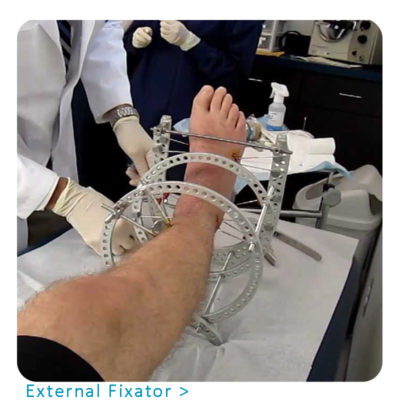
Clinical Indications for Circular External Fixation
- Complex Open Fractures: High-energy Gustilo-Anderson Grade III tibia/femur fractures with soft tissue loss.
- Post-Traumatic Non-Unions: Infected non-unions, pseudoarthrosis, and massive bone defects requiring bone transport.
- Pediatric & Adult Limb Lengthening: Congenital limb length discrepancies (LLD), achondroplasia, and post-traumatic shortening.
- Complex Deformity Correction: Multi-axial angular, translational, and rotational corrections (Blount’s disease, clubfoot, post-traumatic mal-unions).
- Joint Arthrodesis: Charcot foot reconstructive fusion, knee arthrodesis post-septic arthritis, and ankle fusion.
2. Comprehensive Component Breakdown & Product Recommendations
A standard Ilizarov Ring Fixator assembly demands complete interchangeability across modular components. Uteshiya Medicare engineers ring constructs with metric standard thread pitches (M6) to guarantee compatibility across international hospital inventories. Below is our definitive procurement guide detailing essential frame components, material specifications, and recommended clinical applications.
Full & 5/8 Carbon/SS Rings
Engineered with equidistant 8mm outer-diameter holes. Available in inner diameters ranging from 100mm to 240mm. 5/8 rings facilitate unrestricted joint range of motion near the knee and elbow joints.
Inquire NowThreaded & Telescopic Rods
High-tensile metric M6 threaded rods manufactured from cold-worked Stainless Steel 316L or Grade 5 Titanium. Features precision-cut threads ensuring smooth nut movement without galling or jamming.
Inquire NowCannulated Wire Fixation Bolts
Slotted and hole-type wire clamping bolts designed to securely anchor 1.8mm and 2.0mm Kirschner wires. Precision serrated clamping surfaces prevent micro-slippage under high wire tensions (130 kgf).
Inquire NowUniversal Hinges & Distraction Units
Single-axis, universal, and 90-degree angular hinges allowing precise angular correction during deformity reconstruction. Compatible with mechanical click-distractor units for patient self-distraction.
Inquire NowOlive Wires & K-Wires
Bayonet and diamond-tipped K-wires manufactured from surgical 316L SS. Olive wires feature an integrated stopper sphere to push bone fragments during inter-cortical transport and lateral shift correction.
Inquire NowHA-Coated Schanz Screws
Self-drilling and self-tapping 4.5mm, 5.0mm, and 6.0mm Schanz pins with optional Hydroxyapatite (HA) coating. Minimizes thermal necrosis and drastically reduces long-term pin-tract infection rates.
Inquire NowTechnical Material Comparison: Stainless Steel 316L vs. Titanium Grade 5 vs. Carbon Fiber
Selecting the optimal material matrix is critical for tender specification drafting and balancing hospital budgets against biomechanical requirements. Below is a comparative technical matrix designed by our metallurgical quality engineering team:
| Performance Metric | Stainless Steel 316L (ASTM F138) | Titanium Alloy (Ti-6Al-4V ELI ASTM F136) | Carbon Fiber Composite |
|---|---|---|---|
| Density / Weight Ratio | 7.99 g/cm³ (Standard Weight) | 4.43 g/cm³ (45% Lighter than Steel) | 1.55 g/cm³ (Ultra-Lightweight) |
| Tensile Strength (Yield) | ≥ 690 MPa | ≥ 860 MPa | ≥ 750 MPa |
| Radiolucency (X-Ray / CT) | Radiopaque (Causes artifact scatter) | Moderate Radiolucency (Minimal scatter) | 100% Radiolucent (Clear osteogenesis view) |
| Biocompatibility Profile | High (ISO 10993 compliant) | Exceptional (Osseointegration resistant) | High inert composite polymer matrix |
| MRI Safety Profile | Magnetic susceptibility limits 3T MRI | Non-magnetic (3T MRI Safe) | 100% Non-metallic / MRI Safe |
| Cost / Sourcing Efficiency | Most Cost-Effective / High Procurement Volume | Premium Price / Specialized Trauma Cases | High Unit Cost / Specialized Pediatric Use |
3. Future Global Procurement Trends in External Fixation Systems (2025–2030)
The global market for external fixators and limb reconstruction systems is undergoing a structural transformation. Hospital procurement committees, ministry tenders, and international medical device distributors are adjusting their sourcing strategies based on key macro-economic, regulatory, and technological shifts:
A. Shift Toward Modular Sterile Kit Packaging
Traditionally, Ilizarov frames were sourced as bulk non-sterile loose components and assembled manually in Central Sterile Services Departments (CSSD). Modern hospital supply chains are rapidly transitioning to procedure-specific pre-sterilized external fixator kits. Pre-packaged sterile trays reduce Operating Room (OR) setup times by up to 35%, eliminate cleaning and sorting labor, and ensure 100% traceability under Unique Device Identification (UDI) regulations.
B. Diversification Beyond Western OEM Monopolies
Rising healthcare costs across North America, Europe, Latin America, and the Middle East are pushing healthcare networks to diversify away from expensive tier-1 Western manufacturers. Certified Indian manufacturers—such as Uteshiya Medicare—offering CDSCO approvals, ISO 13485 compliance, and equivalent metallurgical purity (ASTM F138/F136) at competitive export prices are capturing substantial market share in global tenders.
C. Stringent Regulatory Compliance (EU-MDR & CDSCO Integration)
Regulatory frameworks globally have tightened dramatically. The transition from EU-MDD to EU-MDR, alongside the enforcement of Indian CDSCO Medical Device Rules (MDR 2017), has eliminated unverified suppliers. Global procurement managers now require comprehensive Technical Master Files (TMF), Biocompatibility Reports (ISO 10993), Mechanical Stress Fatigue Testing Data (ASTM F1541), and full Raw Material Heat Traceability Certificates prior to contract execution.
D. Adoption of Hybrid Fixation Frameworks
Pure transfixion wire frames are increasingly giving way to hybrid external fixators, which combine circular rings in the juxta-articular metaphysis with half-pins in the diaphysis. Sourcing managers are consolidating vendor lists to suppliers capable of manufacturing complete ecosystem interoperability—offering Ilizarov rings, AO-type clamps, and dynamic rail fixators under a single unified catalog.
4. Future Technological Trends: The Next Generation of Ring Fixators
As digital orthopedics and bio-engineering converge, the classic Ilizarov frame is evolving from a mechanical assembly into a smart, computer-assisted reconstruction platform. Procurement managers looking to future-proof their medical device portfolios should monitor four emerging technology vectors:
1. Hexapod Computer-Guided Software Integration
Six-strut hexapod spatial frames combined with 3D web software algorithms represent the growth vanguard. Surgeons input postoperative X-ray parameters and deformity vectors into software programs that generate daily strut adjustment prescriptions. Future Ilizarov rings are being pre-machined with digital optical markers to allow automated software calibration via smartphone cameras.
2. 3D-Printed Custom Radiolucent Ring Geometry
Additive manufacturing using Titanium powder and PEEK (Polyether ether ketone) matrix composites allows the production of patient-specific anatomic rings. Custom contoured rings eliminate bulky frame overlap in pediatric or severe burn patients, dramatically improving patient mobility during long-term rehabilitation.
3. Telemetry & Bio-Sensor Embedded Fixation
Miniaturized load-cell sensors integrated directly into connecting rods are transitioning from clinical trials to commercialization. These micro-sensors measure weight-bearing strain and callus stiffness real-time, transmitting compliance data to the surgeon's telemetry dashboard to optimize distraction speed automatically.
4. Antimicrobial Nano-Coatings on Pin-Tract Implants
Pin-tract infection remains the primary clinical complication in external fixation, occurring in up to 30% of cases. Next-generation Schanz screws and olive wires incorporate silver nanoparticle or Hydroxyapatite-Gentamicin chemical coatings that release local bactericidal agents, suppressing Biofilm formation on the pin-skin interface.
5. B2B Procurement FAQ: Critical Technical Queries Answered
Below are expert answers to high-intent questions frequently queried by global medical purchasing agents, biomedical engineers, and orthopedic importers when evaluating Ilizarov Ring Fixator suppliers.
What are the mechanical yield and fatigue testing standards required for Ilizarov external fixator rings?
Ilizarov components must comply with ASTM F1541 (Standard Specification and Test Methods for External Skeletal Fixation Devices). Rings undergo static radial compression testing, four-point ring bending tests, and dynamic axial fatigue testing (minimum 1,000,000 cycles without structural failure or permanent deformation under cyclic maximum load). Threaded rods are tested to ASTM A370 for axial yield strength (≥ 690 MPa for 316L SS).
How does Uteshiya Medicare prevent thread galling and binding on long M6 threaded rods?
Thread galling is a cold-welding phenomenon common in stainless steel fasteners under load. Uteshiya Medicare utilizes high-precision cold-rolling thread machinery rather than cut threading. Cold-rolled threads produce a smooth surface finish (< Ra 0.4 μm) and work-hardened crystal structure. Furthermore, our proprietary electropolishing passivates the surface layer, ensuring friction-free nut adjustment during prolonged clinical distraction routines.
What is the standard packaging, labeling, and international shipping classification for external fixators?
Our standard export shipments are classified under HS Code 9021.10.00 (Orthopedic or fracture appliances). Individual components are packaged in scratch-resistant, heavy-duty 8-mil polyethylene pouches with moisture-absorbent desiccant, heat-sealed in protective box units. Pre-sterilized sets undergo double-pouch Tyvek sterilization validation (EO or Gamma Irradiation according to ISO 11135 / ISO 11137) with clear 5-year shelf-life indicator labels and UDI barcodes.
What is the recommended inventory starter mix for a regional trauma center or distributor?
For a standard 500-bed hospital trauma inventory, we recommend a core stocking distribution: 40% Full Rings (140mm, 160mm, 180mm inner diameter being most utilized), 20% 5/8 Rings, 15% Curved/Conical Washers and Hinges, 15% M6 Threaded Rods (100mm to 300mm lengths), and 10% Transfixion Wire Bolts & 1.8mm/2.0mm Bayonet-Tip K-Wires. Contact our B2B sales engineers for customized hospital stocking templates.
Can Uteshiya Medicare manufacture custom ring dimensions or OEM private-label external fixator sets?
Yes. As a direct manufacturer with Swiss CNC multi-axis turning centers and vertical machining centers, we provide comprehensive OEM/ODM services. We can customize ring geometries, hole spacing, anodization colors (for Titanium ranges), custom laser-etched branding, and custom container trays based on your technical drawings or CAD file submissions.
6. Enterprise Advantages: Why Global Healthcare Procurement Trusts Uteshiya Medicare
Uteshiya Medicare stands as one of India's premier certified manufacturers and global exporters of trauma, spine, joint, and external fixation implants. Built upon a foundation of engineering precision and uncompromising quality control, our organization bridges the gap between affordable procurement and world-class clinical outcomes.
Manufacturing Rigor
End-to-End In-House Quality Infrastructure
From raw material mill certification to final passivated packaging, every step of our manufacturing workflow takes place within our state-of-the-art facility in Gujarat, India. Our integrated production setup includes:
Partner with a Certified External Fixation Manufacturer
Join healthcare institutions across 30+ countries relying on Uteshiya Medicare for clinical quality, supply chain reliability, and responsive B2B support.