Featured Spinal & Orthopedic Surgical Instrument Sets
Explore our certified product portfolio manufactured under strict ISO 13485 and CE standards. Each system features ultra-precise mechanical tolerances, ergonomic titanium/stainless steel handling, and complete modularity for clinical versatility.
1. Executive Summary & Market Intelligence: Spinal Decompression Sourcing in 2025
The global medical device market is undergoing a structural transformation driven by the acceleration of Minimally Invasive Spine Surgery (MISS), demanding ultra-precise micro-decompression instruments, pedicle fixation access kits, and high-fatigue titanium implants. Sourcing high-grade spinal decompression instrument sets requires strict evaluation of raw material metallurgy, dimensional accuracy tolerances (±0.005mm), surface passivation chemistry, and international regulatory alignment.
As hospital procurement departments, orthopedic distributors, and original equipment procurement officers seek optimal risk mitigation strategies, China and partner certified manufacturing hubs have emerged as central pillars of high-precision surgical production. Evaluating a premier manufacturer requires moving beyond surface-level pricing to inspect Information Gain metrics: total cost of ownership (TCO), cleanroom validation standards (ISO Class 7/8), custom OEM engineering turnaround times, and post-market clinical surveillance data.
Metallurgical Comparison: 316L Stainless Steel vs Ti-6Al-4V ELI (Grade 5 Titanium)
Selecting the correct metallurgical substrate is critical for spinal decompression instruments, rongeurs, osteotomes, and internal compression plates. Below is an engineering evaluation matrix derived from ASTM F138 and ASTM F136 surgical standards:
| Mechanical / Engineering Parameter | 316L Stainless Steel (ASTM F138) | Ti-6Al-4V ELI Titanium (ASTM F136) | Clinical & Sourcing Impact |
|---|---|---|---|
| Tensile Strength (MPa) | 860 - 1100 MPa | 860 - 960 MPa | High rigidity in manual bone-cutting rongeurs and curettes. |
| Modulus of Elasticity (GPa) | 193 GPa | 114 GPa (Closer to cortical bone) | Titanium reduces stress shielding in permanent spinal constructs. |
| MRI Artifact Interference | Moderate-High Magnetic Susceptibility | Ultra-Low Artifact Distortion | Titanium sets essential for postoperative MRI decompression assessment. |
| Surface Passivation & Corrosion | Nitric/Citric Acid Passivated Layer | Self-Healing TiO2 Anodized Film | Prevents micro-pitting during 500+ autoclave steam sterilizations. |
| Machining Complexity & Cost | Standard CNC Milling Efficiency | High Diamond-Tooling Requirement | 316L offers maximum cost-efficiency for disposable/general instrument trays. |
2. Comprehensive Product Recommendations & Clinical Utility
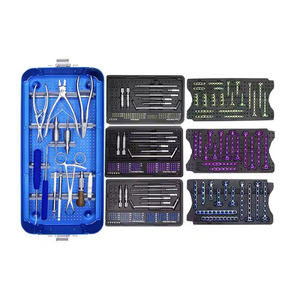
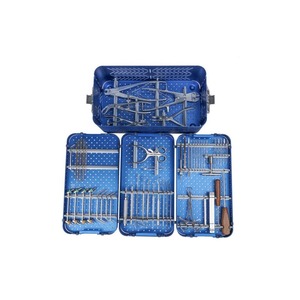
A complete, hospital-ready spinal decompression tray must integrate specialized instrumentation engineered for laminectomy, discectomy, neural decompression, and spinal stabilization. Below are the key instrument categories recommended for global medical tender specifications:
Kerrison Punches & Rongeurs
Engineered with German-spec tungsten carbide inserts, ejector pins, and 40°/90° forward-angled jaws for clean bone excision during nerve root decompression without thermal necrosis.
Tubular Decompression Retractors
Radiolucent titanium access ports paired with fiber-optic light guide clips, enabling micro-endoscopic discectomy (MED) with minimal muscle tissue destruction.
Modular Micro-Fragment Fixation
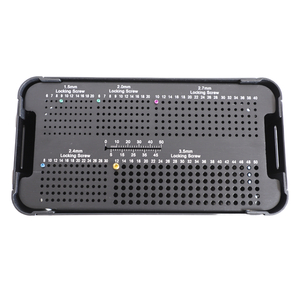
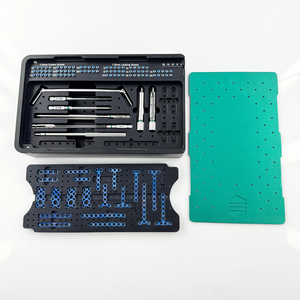
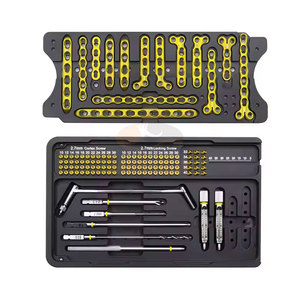
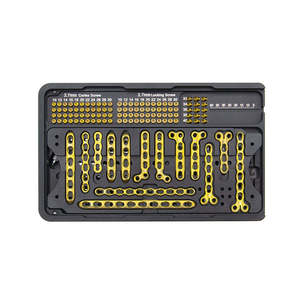
Standardized 1.5mm/2.0mm/2.7mm locking plates and screws for complex occipitocervical, CMF, and small-fragment reconstructive procedures requiring high fatigue stability.
3. Future Procurement Trends in Spinal Instrument Manufacturing
Procurement officers must anticipate regulatory and technological shifts over the next 5 to 10 years to maintain competitive advantage and supply chain stability. Key developments reshaping B2B purchasing include:
Key Strategic Purchasing Trends (2025–2030)
- Integration with Robotic Navigation Systems: Decompression instruments are increasingly manufactured with optical calibration markers and electromagnetic sensor mounts to interface seamlessly with surgical robotics (e.g., Mazor, Rosa, Globus).
- Carbon-Fiber Reinforced PEEK Handles: Transitioning from heavy metallic handles to lightweight, radiolucent carbon-PEEK composites reduces surgeon hand fatigue during lengthy multi-level fusion and laminectomy procedures.
- Unique Device Identification (UDI) Direct Laser Marking: Global regulatory bodies (FDA, EU MDR) mandate high-contrast GS1 2D DataMatrix barcode engraving on every instrument for automated tracking and sterilization lifecycle auditing.
- Shift Toward Single-Use Modular Kits: To combat hospital-acquired infections (HAIs) and eliminate re-sterilization overhead, pre-packaged sterile single-use spinal decompression sets are capturing significant market share in outpatient ambulatory surgical centers (ASCs).
4. Technological Innovations & Manufacturing Standards
The precision of modern spinal surgical instruments is heavily dependent on advanced manufacturing methodology. Industry-leading Chinese suppliers leverage state-of-the-art 5-axis CNC Swiss lathe machining, wire EDM (Electrical Discharge Machining), and robotic hand-polishing to achieve sub-micron fidelity.
Furthermore, surface functionalization technology—such as Diamond-Like Carbon (DLC) coating—increases surface hardness to >2500 HV (Vickers), drastically reducing friction on sliding cutting shafts (such as Kerrison footplates) and eliminating metallic debris shedding during bone nibbling.
5. Enterprise Superiority: Why Partner With Us
As a certified global orthopedic implants and surgical instruments manufacturer, our facility integrates high-precision engineering with complete regulatory compliance. Our competitive advantages include:
Certified Quality Management
Operating under strict ISO 13485:2016, CDSCO, and FDA registration guidelines. Every lot undergoes 100% optical CMM inspection before sterile packaging.
In-House Cleanroom & Sterilization
Class 10,000 (ISO Class 7) cleanroom facilities equipped for bioburden-controlled assembly, gamma radiation, and EO sterilization packaging.
Global Export Reach (30+ Countries)
Proven logistics pipeline supplying major hospitals, governmental healthcare tenders, and private medical distributors across Europe, Asia, and the Americas.
Custom CAD/CAM & CT-Based OEM
Dedicated R&D team capable of translating surgeon feedback, DICOM CT scans, and proprietary engineering drawings into physical prototypes within 14 business days.