Featured Orthopedic Implants & Fixation Systems
Precision-engineered spinal, trauma, and micro fragment locking systems produced under certified cleanroom conditions
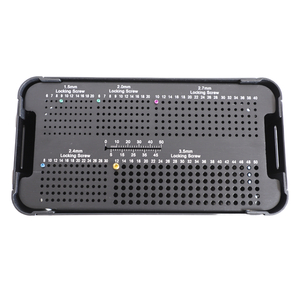
Veterinary Mini Micro Fragment System Stainless Steel Trauma Plates
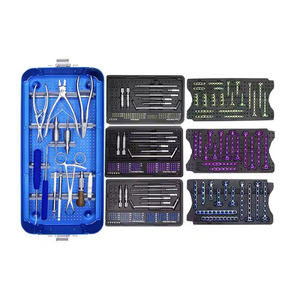
Manual Mini Micro Fragment Locking Plate System 1.5/2.0/2.4mm Set
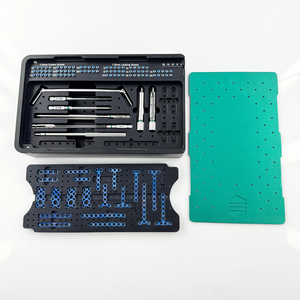
Veterinary 1.5mm Mini Micro Fragment Titanium Locking Kit
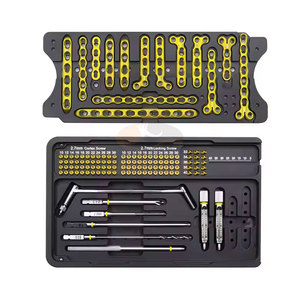
Premium Orthopedic Mini Fragments 2.7mm Locking Plate Set
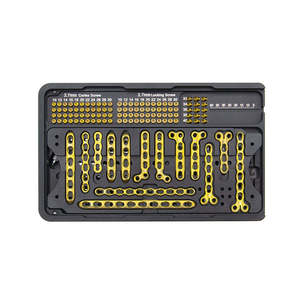
Manual Mini Fragments 2.7mm Steel Locking Plate Instrument Set
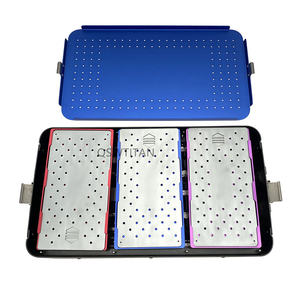
Orthopedic Mini Fragment Plate & Screw System for Finger & Palm
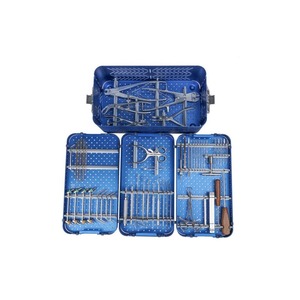
Hand, Foot, Wrist & Maxillofacial Locking Plate Surgical Kit
Eaven Mini Micro Fragment System Veterinary Surgical Implants
Manufacturing Infrastructure & OEM Core Competencies
Empowering international spine brand distributors, hospital groups, and medical importers through verified ISO13485 engineering excellence.
Certified Quality Assurance
Full regulatory dossier compliance under ISO 13485 quality management systems, CDSCO manufacturing licenses, and FDA device registration protocols ensuring seamless clinical approval worldwide.
In-House Sterile Facility
Integrated ISO Class 7 (Class 10,000) cleanrooms operating automated ultrasonic washing, clean packaging lines, and validated EO (Ethylene Oxide) or Gamma irradiation sterilization cycles.
Advanced Metallurgy & CNC
Utilizing high-purity Titanium Alloy (Ti-6Al-4V ELI Grade 23) and 316L Implant Stainless Steel machined via 5-axis DMG MORI and Citizen Swiss CNC lathes for microscopic thread accuracy.
Thoracolumbar Pedicle Screw System: Engineering & Biomechanical Whitepaper
An authoritative analysis of anatomical forces, thread geometry, polyaxial friction lock mechanism, and clinical pull-out strength optimization
1. Clinical Demands of Spinal Fixation in the T1-L5 / S1 Segment
The thoracolumbar junction (T10-L2) and lower lumbar spine represent regions of extreme mechanical stress within the human skeleton, subjecting posterior implants to high-magnitude axial loading, rotational torque, and multi-directional flexion-extension moments. When stabilizing vertebral fractures, degenerative disc disorders, spondylolisthesis, or spinal deformities, the thoracolumbar pedicle screw system serves as the primary rigid load-bearing anchor.
To eliminate implant loosening, screw toggle, and fatigue failure prior to solid osseous fusion, leading Chinese medical device factories have optimized pedicle screw designs with dual-lead helical threads, self-tapping flutes, and variable angular friction collars. By maintaining a high pitch ratio (converting rotational driving force into smooth insertion torque), modern screws reduce cortical micro-fracturing during surgical placement while increasing pullout resistance by up to 34% compared to legacy single-thread designs.
2. Polyaxial vs. Monoaxial Mechanics and Angle Variances
Surgical access and anatomical deformity often prevent co-planar alignment of pedicle screw heads along the longitudinal spinal rod trajectory. Modern thoracolumbar systems integrate two primary head configurations:
- Polyaxial Pedicle Screws: Feature a spherical screw head housed inside an outer saddle, allowing a 360-degree cone of motion with up to 55 degrees of angulation. This angulation reduces rod-contouring stress and minimizes shear force transferred to the bone-implant interface.
- Monoaxial Pedicle Screws: Maintain a rigid, perpendicular orientation between the screw shank and saddle. Ideal for direct axial traction, vertebral translation, and rigid fracture reduction where maximum lever arm strength is clinically required.
- Reduction Pedicle Screws: Designed with extended break-away tabs (reduction collar) to incrementally pull displaced vertebrae toward the pre-curved titanium rod in spondylolisthesis corrections.
Top-tier China suppliers utilize cold-forged inner locking set screws (grub screws) engineered with reverse-angle buttress threads. This micro-geometry prevents outer saddle expansion under high tightening torque (typically 5.0 to 12.0 Nm), eliminating set-screw cross-threading and postoperative back-out.
| Evaluation Parameter | Ti-6Al-4V ELI (Grade 23) | 316L Medical Stainless Steel | Clinical / Procurement Significance |
|---|---|---|---|
| Ultimate Tensile Strength (MPa) | ≥ 860 MPa | ≥ 690 MPa | Higher resistance to bending under heavy biomechanical loads. |
| Modulus of Elasticity (GPa) | 110 GPa (Closer to cortical bone) | 200 GPa | Titanium reduces stress shielding at adjacent spinal segments. |
| MRI / CT Artifact Clearance | Low Magnetic Susceptibility | Moderate Artifact Distortion | Titanium enables clearer postoperative neuro-imaging diagnostics. |
| Fatigue Resistance (ASTM F1717) | > 5,000,000 Cycles @ 75% Yield | > 5,000,000 Cycles @ 65% Yield | Verifies long-term implant endurance prior to bony fusion. |
| Surface Treatment Options | Type II Anodization / HA Coating | Electropolished Passivation | Type II anodization increases surface hardness and reduces fretting wear. |
Global Market Trends & Procurement Forecast (2025–2030)
Key technological innovations driving hospital demand and OEM manufacturing advancements in China
1. Minimally Invasive (MIS) Percutaneous Pedicle Screws
Surgical trends show a rapid shift from traditional open spinal procedures to Minimally Invasive Spine Surgery (MISS). Percutaneous pedicle screw systems featuring cannulated shanks, extended k-wire guidance channels, and integrated slot-extenders allow surgeons to insert screws through small skin incisions. Procurement heads must source suppliers offering cannulated screws with wall-thickness consistency to prevent k-wire jamming during minimally invasive spine fusion.
2. Robotic Integration & Navigation Calibration
With the global adoption of optical and electromagnetic surgical navigation systems (such as Medtronic StealthStation and Mazor Robotics), thoracolumbar implants must meet sub-millimeter manufacturing tolerances. Leading Chinese manufacturers are equipping screw saddles with optical tracker registration markers and universal hex-driver couplings to ensure zero-play alignment with surgical robotic end-effectors.
3. Cement-Augmented Screws for Osteoporotic Bone
Aging global demographics have increased the prevalence of severe osteoporosis, making standard pedicle screw fixation prone to early pullout. Next-generation systems incorporate fenestrated pedicle screws capable of injecting PMMA (Polymethylmethacrylate) bone cement through lateral port holes near the screw tip. This creates an anchored cement mantle within trabecular bone, boosting anchorage force by over 200% in osteopenic spines.
4. 3D-Printed Porous Surfaces & Dynamic Stabilization
Additive manufacturing (Selective Laser Melting / SLM) allows manufacturers to produce pedicle screws with porous micro-structures directly on the unthreaded neck or integrate dynamic PEEK/Titanium hybrid rods. These dynamic systems absorb physiological bending loads while preserving partial segmental mobility, mitigating adjacent segment disease (ASD) in lumbar spine reconstruction.
Frequently Asked Questions for Global Procurement Officers
Direct technical insights to simplify vendor qualification, regulatory compliance, and custom OEM ordering
How do China pedicle screw factories verify biomechanical safety and fatigue strength?
Reputable manufacturers perform rigorous mechanical testing according to ASTM F1717 (Standard Test Methods for Spinal Implant Constructs in a Vertebrectomy Model) and ISO 12189. This includes static compression bending, static torsion, and dynamic fatigue testing up to 5 million cycles to ensure implants withstand repeated physiological loads without structural fracturing.
What raw material grades are used in manufacturing thoracolumbar systems?
Implants are machined from medical-grade Titanium Alloy Ti-6Al-4V ELI (ASTM F136 / ISO 5832-3) or 316L Stainless Steel (ASTM F138 / ISO 5832-1). Material test reports (MTRs) and mill heat certificates are provided with every batch to verify chemical purity, grain size, and mechanical yield strength.
Can Chinese suppliers provide full OEM/ODM private labeling and custom tray configurations?
Yes. Established suppliers offer comprehensive OEM/ODM services, including custom thread geometry design, laser marking of lot numbers and brand logos, anodized color coding (for diameter recognition), custom instrument container layout, and individualized sterile blister packaging tailored to market requirements.
What regulatory registration documentation (STED) is supplied for national health registration?
Suppliers provide technical dossiers formatted per STED (Summary Technical Documentation), including ISO 13485 certificates, ISO 10993 biocompatibility testing (cytotoxicity, sensitization, systemic toxicity), sterilization validation reports (ISO 11135 for EO / ISO 11137 for Gamma), and clinical evaluation reports (CER).
What is the standard production lead time and Minimum Order Quantity (MOQ) for B2B contracts?
Standard stocked components (e.g., standard polyaxial screws and 5.5mm titanium rods) have low MOQs starting from 50–100 pieces per size. Custom OEM production runs typically require 4 to 6 weeks for precision CNC machining, washing, anodization, cleanroom packing, and final quality inspection.
How are screw thread tolerances and locking mechanisms quality controlled during mass production?
Quality assurance utilizes automated 2D optical measuring projectors, CMM (Coordinate Measuring Machines), thread pitch gauges, and 100% digital torque testing for set-screw engagement to guarantee zero cross-threading and exact friction-fit tolerances during surgery.