Featured Wrist Joint External Fixators & Orthopedic Systems
Precision-engineered trauma fixation implants trusted by orthopedic surgeons across New York state
Biomechanics of Distal Radius External Fixation: Surgical Standards & Load Mitigation
Distal radius fractures constitute approximately 18% of all adult fractures presenting to emergency trauma centers across Metropolitan New York. When managing unstable, high-energy intra-articular distal radius fractures (AO/OTA Type 23-C2 and C3), surgical intervention via open reduction and internal fixation (ORIF) may be contraindicated due to severe soft-tissue compromise, extensive metaphyseal comminution, or severe open wounds. In these critical clinical scenarios, wrist joint external fixators serve as the definitive gold standard for restoration of radiocarpal alignment and articular congruity.
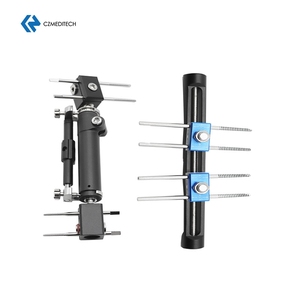
The biomechanical performance of a wrist external fixation construct relies heavily on frame rigidity, pin-to-bone interface stability, and the mechanical properties of the connecting elements. Modern orthopedic trauma protocols in top-tier New York surgical institutions mandate the integration of radiolucent carbon-fiber rods coupled with Grade 5 Titanium (Ti-6Al-4V ELI) or 316L Stainless Steel Schanz pins. Carbon-fiber components eliminate radiopaque artifact during intraoperative fluoroscopy (C-arm guidance), allowing surgical teams to precisely verify articular step-off reductions under real-time imaging.
Bridging vs. Non-Bridging Frame Configurations
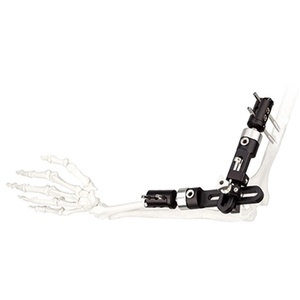
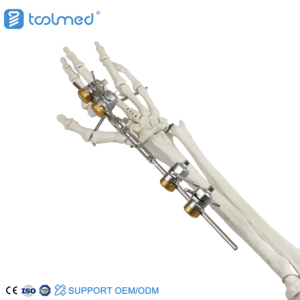
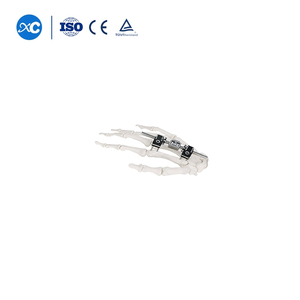
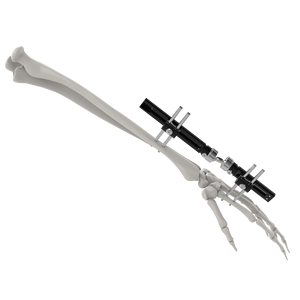
Surgical selection between bridging (distractor anchored from radial shaft to index metacarpal) and non-bridging (pin placement confined strictly to the proximal and distal radial fracture fragments) depends on metaphyseal bone stock length. Bridging frames minimize stress concentration at the fracture site by bypassing the carpal bones entirely, whereas articulated joint hinges permit early controlled wrist flexion and extension without sacrificing reduction stability.
- Optimal Schanz Pin Insertion Angle: 30° to 45° to the sagittal plane
- Recommended Radial Shaft Pin Diameter: 3.0mm to 4.0mm self-tapping thread
- Index Metacarpal Pin Diameter: 2.5mm to 3.0mm tapered core design
- Thermal Necrosis Mitigation: Low-speed power drilling under constant saline irrigation
Preventing Neurovascular Compromise
Percutaneous pin placement into the distal radius carries an intrinsic risk of injury to the Superficial Branch of the Radial Nerve (SBRN) and the Extensor Pollicis Longus (EPL) tendon. Surgical techniques in New York trauma centers emphasize small longitudinal skin incisions combined with blunt dissection down to the periosteum using soft-tissue protection sleeves prior to pre-drilling. This rigorous protocol drastically reduces pin-tract irritation, tendon tethering, and post-operative complex regional pain syndrome (CRPS).
- Pin Insertion Safety Zone 1: Proximal radius between ECRL & ECRB tendons
- Pin Insertion Safety Zone 2: Base of 2nd Metacarpal dorsal-radial edge
- Rigid Multi-planar Clamps: Reduce micro-motion < 0.5mm under peak loads
- Biocompatible Hydroxyapatite Coating: Enhances pin-bone interface shear strength
New York Regional Clinical Applications & Health System Trends
Customized external fixation supply strategies tailored to Level 1 Trauma Centers and ASC networks across New York
Level 1 & 2 Urban Trauma Hubs
In high-density medical facilities such as NYC Health + Hospitals/Bellevue, Mount Sinai Hospital, NYU Langone Health, and NewYork-Presbyterian, orthopedic emergency teams require rapid-assembly modular external fixators. Our unilateral dynamic wrist fixators enable rapid stabilization of multi-trauma patients in damage control orthopedics (DCO) settings within minutes of emergency room arrival.
Upstate NY Winter Trauma Demand
Healthcare networks in Upstate New York—including Albany Medical Center, Strong Memorial Hospital in Rochester, and Erie County Medical Center in Buffalo—experience sharp seasonal spikes in severe distal radius fractures caused by extreme icy conditions and winter sports injuries. Bulk supply readiness ensures zero stock-out risks for regional orthopedic departments during peak winter months.
Ambulatory Surgery Centers (ASCs)
With New York’s rapid expansion of outpatient Ambulatory Surgery Centers in Long Island and Westchester County, surgeons demand pre-sterilized, single-use procedure kits. Uteshiya Medicare provides complete sterile-packaged mini and standard wrist external fixator trays, streamlining sterile processing department (SPD) workflows and lowering institutional overhead costs.
Enterprise Advantages & Global Manufacturing Standards
Why leading healthcare procurement officers and orthopedic surgeons choose Uteshiya Medicare
Uteshiya Medicare (Kaisen Medical Care) stands as an elite global manufacturer and exporter of orthopedic implants and instrumentation systems. Operating under strict CDSCO approval, ISO 13485 quality management systems, and FDA regulatory compliance, our manufacturing infrastructure delivers unparalleled precision across over 1,000 certified implant SKUs.
Every wrist joint external fixator component undergoes rigorous mechanical testing—including fatigue strength evaluation under dynamic cyclic loading, torsional resistance testing, and dimensional verification via automated optical coordinate measuring machines (CMM). Our raw materials are exclusively sourced from certified medical-grade supplier channels, utilizing high-purity Grade 5 Titanium Alloy (Ti-6Al-4V ELI) and 316L Implant-Grade Surgical Stainless Steel.
- State-of-the-Art Swiss-type CNC Lathes & 5-Axis Machining Centers
- In-House Class 10,000 Cleanroom & Automated Gamma/EO Sterilization
- Full Traceability with Laser-Etched Unique Device Identifiers (UDI)
- Patient-Specific Custom Implant CAD/CAM Engineering Support
Supply Chain Excellence for New York Hospitals
Eliminate intermediary distributor markups while maintaining 100% compliance with US healthcare procurement budgets.
Customized consignment inventory models available for New York hospital networks with rapid 24-48 hour replenishment delivery.
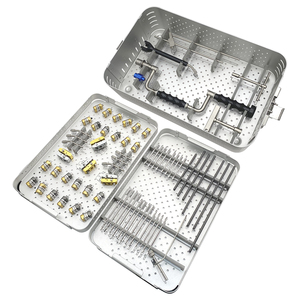
Complete surgical sets including drill bits, tissue protectors, T-wrenches, and universal pin drivers for seamless OR integration.
Frequently Asked Questions by New York Medical Buyers
Technical, regulatory, and procurement insights for wrist joint external fixation systems
What certifications do your wrist external fixator systems carry for US import?
Our manufacturing facility and orthopedic implants strictly adhere to international regulatory standards, holding CDSCO approvals, ISO 13485:2016 quality certifications, ISO 9001 compliance, and FDA registration. Full documentation packages, material test reports (MTR), and Certificate of Analysis (CoA) are provided with every shipment to New York buyers.
Are carbon-fiber components radiolucent under intraoperative fluoroscopy?
Yes. Our premium wrist fixator systems incorporate 100% radiolucent carbon-fiber connecting rods. This guarantees completely unobstructed C-arm fluoroscopic visualization of the radiocarpal joint during reduction maneuvers, allowing surgeons to precisely assess intra-articular step-off and radial length restoration.
What are the standard lead times for hospital orders delivered to New York?
Standard air freight orders dispatched directly to New York international airports (JFK / EWR / LGA) typically arrive within 4 to 7 business days. For institutional contracts and GPO partners, we establish localized buffer inventory within regional logistics centers to support overnight emergency deliveries.
Do you supply both Titanium and Stainless Steel Schanz pin options?
Yes. We offer self-tapping Schanz pins in both Grade 5 Titanium (Ti-6Al-4V ELI) and 316L Stainless Steel. Titanium pins provide superior biocompatibility and reduced artifact, whereas 316L SS pins offer extreme rigidity for demanding heavy-load trauma fixations.
Can system components be re-sterilized in standard hospital autoclaves?
All non-sterile metallic clamps and carbon rods are constructed from premium autoclavable materials validated for standard steam sterilization cycles (134°C / 273°F for 4 minutes). Pre-sterilized disposable kits are also available upon request.
How do I request OEM or custom modification for specific surgical trays?
Our dedicated engineering department works directly with hospital surgical committees and distributors. You can initiate a custom tray design or OEM query by clicking the "Inquire Now" button to connect directly with our technical engineering representatives.
Partner with a Leading Global Wrist Fixator Manufacturer
Elevate your orthopedic supply chain in New York with CDSCO & ISO-certified external fixator systems. Direct factory quotes, compliance documentation, and sample kits delivered promptly.
Inquire Now